
Every year, the IBA Annual Conference draws thousands of lawyers from across the world who fill their dockets with meetings, exchange business cards, attend receptions, and capture moments throughout a week brimming with conversations.
But then, reality sets in – you are back at the office, client work takes over, meetings turn into distant memories, and business cards are filed away, often leading to no follow-up action other than the usual perfunctory exchange. The IBA paradox is that law firms can engage in 40 meetings over four days yet return with little to show for it.
The issue, is not the lack of networking, it is the absence of strategy. Success at the IBA is frequently measured by the number of meetings, which only indicate busyness rather than accomplishments.
The true value of the IBA Conference lies not in the quantity of lawyers you meet but in the market insights you gain, the relationships you nurture, and the business development opportunities you seize.
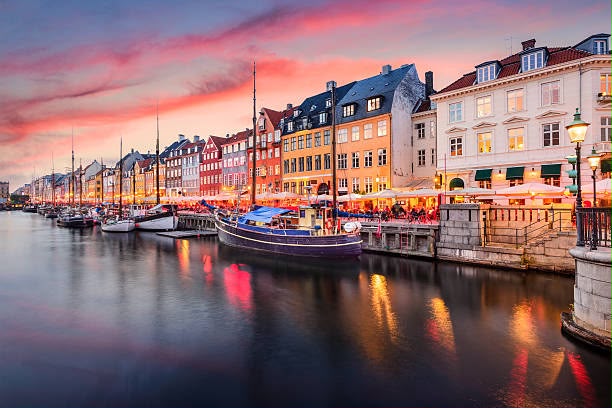
This year, that value proposition has a specific address: Copenhagen.
A Market That Punches Above Its Size
Denmark is a small economy carrying an outsized share of Nordic deal-making. According to KPMG’s Nordic Deal Trend Report (Q4 2025, data courtesy of Mergermarket), Denmark accounted for 182 of the 610 announced deals with Nordic targets in the fourth quarter alone – the largest share of any of the four Nordic markets, ahead of Sweden (162), Norway (156), and Finland (110). Nordic-wide, quarterly deal activity held at roughly 1,040 announced transactions through 2025, with average deal value rising to EUR 45.4 billion from EUR 43.9 billion in 2024, as financing conditions eased through the year and sellers returned to processes with more realistic valuation expectations.
IMAP’s own coverage of the Danish market adds a complementary data point: nearly two-thirds of Denmark’s M&A transactions involve an international buyer – a reflection of its advanced industrial base, technology ecosystem, and leadership in sustainability- linked innovation. Denmark functions less as a Nordic feeder market and more as a genuine entry point for global capital into Northern Europe.
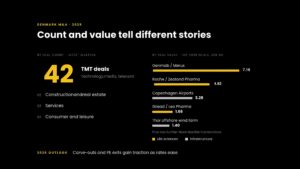
Deal count and deal value tell different stories here. By count, technology, media and telecommunications leads Denmark’s activity (42 deals in the latest quarter), followed by construction and real estate, services, and consumer and leisure. But the ten largest Danish deals of 2025 were overwhelmingly life sciences and infrastructure: Genmab’s EUR7.16 billion acquisition of Merus, Roche’s EUR4.82 billion purchase of Zealand Pharma, two separate Novo Nordisk transactions, Gilead’s EUR1.66 billion Leo Pharma partnership, and infrastructure plays including Copenhagen Airports (EUR3.28 billion) and the Thor offshore wind farm (EUR1.4 billion). Denmark’s life sciences base and energy- transition infrastructure is where the largest cross- border cheques get written, even as technology drives the highest transaction volume. KPMG’s outlook for 2026 points the same direction – corporate carve- outs and separations, and private equity exits via trade sales and sponsor- to- sponsor deals, are both positioned to gain traction as rates ease.
Where The Value Concentrates
The India Story
This is not a trend confined to European counterparties – Danish capital has shown up directly in Indian dealmaking over the past year, across sectors that mirror the data above almost exactly.
In renewable energy – the segment KPMG flags as gaining sustained momentum on decarbonization and grid investment themes – Investment Fund Denmark (formerly IFU) and FMO jointly committed USD 100 million into Radiance Renewables, an India- focused commercial and industrial renewables platform backed by Eversource Capital, to fund its expansion across solar, hybrid wind- solar, and battery storage. Cyril Amarchand Mangaldas advised Eversource Capital and Radiance Renewables; DMD Advocates advised Investment Fund Denmark and FMO (as reported by The Deal Matter).
The same Danish vehicle appears on the other side of the cycle in a second deal: Impact Fund Denmark (IFU- DSDG), an existing investor in CleanMax Enviro Energy Solutions – one of India’s largest C&I renewable energy providers – sold down part of its stake to the CleanMax founder group, alongside Brookfield Renewables and Augment Infrastructure. AZB & Partners advised the CleanMax promoter group on the acquisition and its financing; Saraf and Partners advised DSDG Holdings ApS on the sale (also reported by The Deal Matter). Read together, the two deals show Danish development capital active on both entry and exit in Indian renewables within the same year – a market it continues to work, not a one- off allocation.
The corridor is not limited to energy. Cyril Amarchand Mangaldas also advised Reliance Industries’ RISE Worldwide on a joint venture between BLAST Esports (a Reliance/Jio unit) and BLAST ApS, the Denmark- based esports and gaming media company – combining BLAST’s production expertise, publisher relationships and IP with Jio’s distribution and local reach on the Jio Games platform. Three independent transactions, three different sectors – impact investing, infrastructure, and media/technology IP – and one recurring country pairing.
Preparation Is The Strategy
None of this data is useful if it stays as background reading. The firms that leave Copenhagen with something to show for it will be the ones who did three things before they landed: read the region and ask more questions, so a conversation about Denmark’s energy transition or life sciences base is not news to them; read the deals, so when a Danish counterpart mentions a renewables mandate or a cross- border JV, there is already a reference point in the room; and read the lawyer, not just the firm – knowing whether the person across the table led a due diligence team on a USD 100 million infrastructure deal or a cross- border IP joint venture changes what you ask them and what you offer in return.
The gap between meetings matters as much as the meetings themselves. Book an hour, not fifteen minutes, between conversations – not for coffee, but to write down what just happened before the next room, the next name, and the next agenda erases it. If a diary won’t do it in the moment, a voice note to yourself right after walking out works just as well. Yes, it looks strange talking into your phone in a hotel corridor. People will notice, they will wonder, and they will move on within a day – and you would have given them a small, harmless story about the lawyer who talks to herself/ himself/themselves between meetings, while you walk away with an accurate record instead of a reconstructed one (basis memory and no amount of magnesium supplements are going to come in handy!).
Keep everything in one place, filed the way the week unfolds: by day, in the sequence the meetings happen. The itinerary tells you where you are supposed to be. The folder of profiles – who they are, what they have worked on, why this meeting is on the calendar – tells you what you already know before you sit down. Together, that is the method.
What you don’t need is a script. Don’t divide the conversation into questions to get through in order – that’s how meetings start to feel like interviews, and counterparts can tell. Let the conversation go where it goes. The structure is not in what you say – it is in what you walked in already knowing, and where you write it down the moment you walk out. Everyone develops their own method to the madness of a week like this – the point is not to eliminate the madness, it is to trust the method enough to let the madness on the ground actually happen, in the conversations, without losing the thread afterward.
That method starts before you land.
As consultants, we have done a part of the job – giving you a glimpse into the region, and the deals moving through it. What is left is the method itself: the itinerary, day-wise and sequenced, and the folder of profiles that sits alongside it, so what you carry into Copenhagen is already assembled, leaving you free for the conversation.
Author: Shreya Sharma