
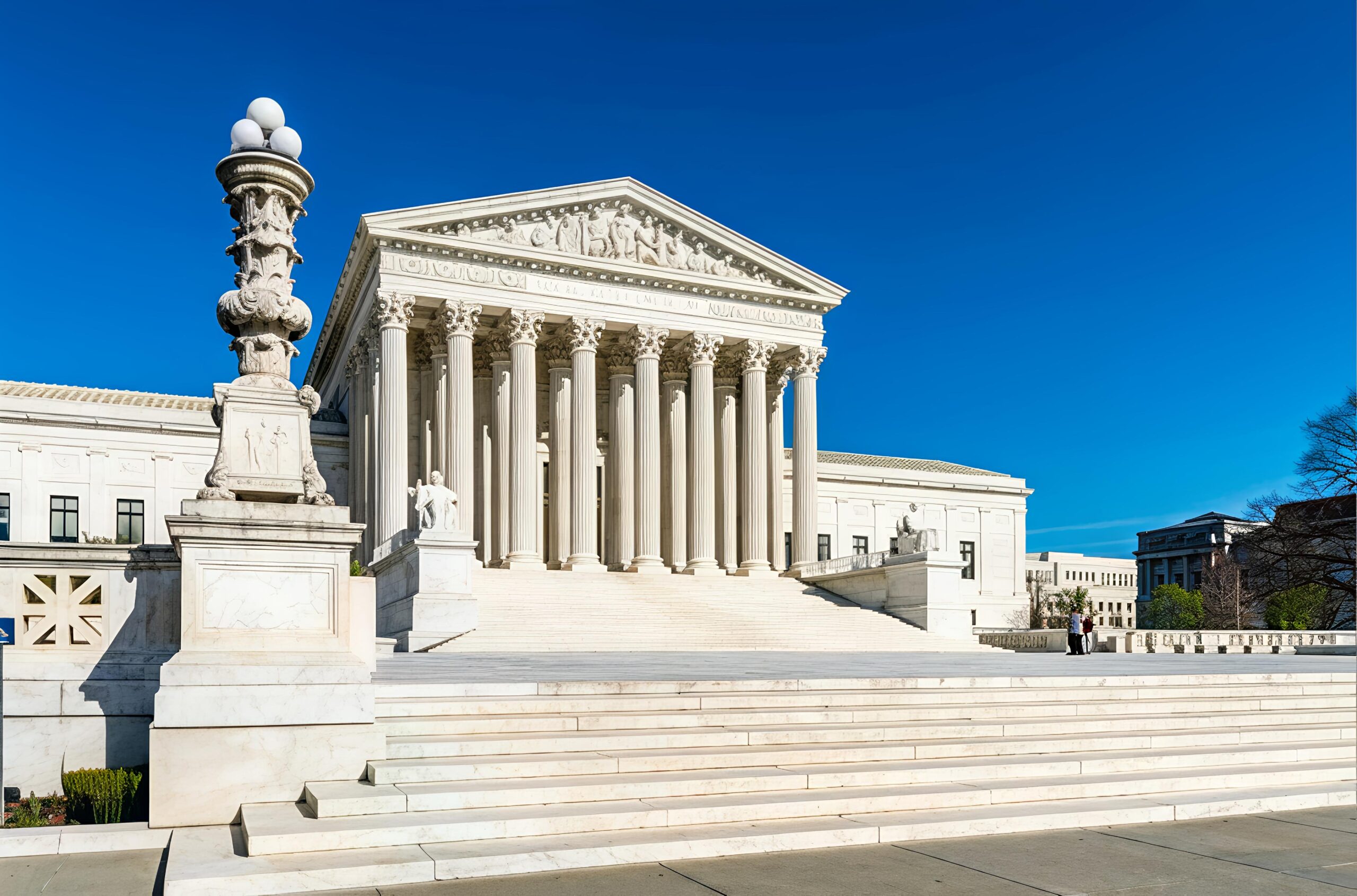
Supreme Court of The United States (SCOTUS) struck down the sweeping Global tariffs imposed by President Donald J. Trump noting that “The Framers gave “Congress alone” the power to impose tariffs during peacetime.”
The Court was examining the question that whether the International Emergency Economic Powers Act (IEEPA) authorizes the President to impose tariffs.
SCOTUS delivered a 6-3 majority judgment on February 20, 2026. Chief Just John Roberts announced the judgment of the Court and delivered the opinion of the Court with respect to Parts I, II–A–1, and II–B, in which Justices Sonia Sotomayor, Elena Kegan, Neil Gorsuch, Amy Coney Barrett, and Ketanji Brown Jackson, joined, and an opinion with respect to Parts II–A–2 and III, in which Justice Gorsuch and Justice Barrett joined. While Justice Gorsuch and Barrett filed concurring opinions, Justice Kagan, filed an opinion concurring in part and concurring in the judgment, in which Justices Sotomayor and Jackson joined.
Justice Jackson filed an opinion concurring in part and concurring in the judgment.
Justice Clarence Thomas, filed a dissenting opinion. Justice Brett Kavanaugh, filed a dissenting opinion, in which Justices Thomas and Samuel Alito joined.
Background
Shortly after taking office, President Trump sought to address two foreign threats: the influx of illegal drugs from Canada, Mexico, and China.
The President imposed tariffs to deal with each threat. As to the drug trafficking tariffs, the President imposed a 25% duty on most Canadian and Mexican imports and a 10% duty on most Chinese imports. As to the trade deficit (“reciprocal”) tariffs, the President imposed a duty “on all imports from all trading partners” of at least 10%, with dozens of nations facing higher rates. Since imposing each set of tariffs, the President has issued several increases, reductions, and other modifications.
Chief Justice John Robert’s Opinion
The Chief Justice delivered the opinion of the Court with respect to Parts I and II–A–1:
Article I, Section 8, of the Constitution specifies that “The Congress shall have Power To lay and collect Taxes, Duties, Imposts and Excises.” The Framers recognized the unique importance of this taxing power—a power which “very clear[ly]” includes the power to impose tariffs. Gibbons v. Ogden, 9 Wheat. 1, 201. And they gave Congress “alone . . . access to the pockets of the people.” The Federalist No. 48, p. 310 (J. Madison). The Framers did not vest any part of the taxing power in the Executive Branch. See Nicol v. Ames, 173 U. S. 509, 515.
The Government thus concedes that the President enjoys no inherent authority to impose tariffs during peacetime. It instead relies exclusively on IEEPA to defend the challenged tariffs. It reads the words “regulate” and “importation” to effect a sweeping delegation of Congress’s power to set tariff policy—authorizing the President to impose tariffs of unlimited amount and duration, on any product from any country. 50 U. S. C. §1702(a)(1)(B). Pp. 5–7.
The Chief Justice, joined by Justice Gorsuch and Justice Barrett, concluded in Part II–A–2:
The Court has long expressed “reluctan[ce] to read into ambiguous statutory text” extraordinary delegations of Congress’s powers. West Virginia v. EPA, 597 U. S. 697, 723 (quoting Utility Air Regulatory Group v. EPA, 573 U. S. 302, 324). In several cases described as involving “major questions,” the Court has reasoned that “both separation of powers principles and a practical understanding of legislative intent” suggest Congress would not have delegated “highly consequential power” through ambiguous language. Id., at 723–724. These considerations apply with particular force where, as here, the purported delegation involves the core congressional power of the purse. Congressional practice confirms as much. When Congress has delegated its tariff powers, it has done so in explicit terms and subject to strict limits.
Against that backdrop of clear and limited delegations, the Government reads IEEPA to give the President power to unilaterally impose unbounded tariffs and change them at will. That view would represent a transformative expansion of the President’s authority over tariff policy. It is also telling that in IEEPA’s half century of existence, no President has invoked the statute to impose any tariffs, let alone tariffs of this magnitude and scope. That “ ‘lack of historical precedent,’ coupled with the breadth of authority” that the President now claims, suggests that the tariffs extend beyond the President’s “legitimate reach.” National Federation of Independent Business v. OSHA, 595 U. S. 109, 119 (quoting Free Enterprise Fund v. Public Company Accounting Oversight Bd., 561 U. S. 477, 505). The “ ‘economic and political significance’ ” of the authority the President has asserted likewise “provide[s] a ‘reason to hesitate before concluding that Congress’ meant to confer such authority.” West Virginia, 597 U. S., at 721 (quoting FDA v. Brown & Williamson Tobacco Corp., 529 U. S. 120, 159–160). The stakes here dwarf those of other major questions cases. And as in those cases, “a reasonable interpreter would [not] expect” Congress to “pawn[]” such a “big-time policy call[] . . . off to another branch.” Biden v. Nebraska, 600 U. S. 477, 515 (BARRETT, J., concurring).
There is no exception to the major questions doctrine for emergency statutes. Nor does the fact that tariffs implicate foreign affairs render the doctrine inapplicable. The Framers gave “Congress alone” the power to impose tariffs during peacetime. Merritt v. Welsh, 104 U. S. 694, 700. And the foreign affairs implications of tariffs do not make it any more likely that Congress would relinquish its tariff power through vague language, or without careful limits. Accordingly, the President must “point to clear congressional authorization” to justify his extraordinary assertion of that power.
IEEPA’s grant of authority to “regulate . . . importation” falls short. IEEPA contains no reference to tariffs or duties.
The Government points to no statute in which Congress used the word “regulate” to authorize taxation. And until now no President has read IEEPA to confer such power.
We claim no special competence in matters of economics or foreign affairs. We claim only, as we must, the limited role assigned to us by Article III of the Constitution. Fulfilling that role, we hold that IEEPA does not authorize the President to impose tariffs.
Justice Brett Kavanaugh’s Dissent
“Tariffs on foreign imports are significant tools of foreign policy and national security, whether imposed under IEEPA, TWEA, Section 232, Section 122, Section 201, Section 301, or Section 338. They are often used to“advance foreign policy goals, or as negotiating leverage in “Trade negotiations.” Congressional Research Service, U. S. Tariff Policy: Overview 1 (2025). Like other economic tools, tariffs can “serve as a ‘bargaining chip’ to be used by the President when dealing with a hostile country,” Dames & Moore v. Regan, 453 U. S. 654, 673 (1981)—or to incentivize a change in behaviour by allies, partners, or enemies. Cf. Association of American Railroads, 575 U. S., at 80 (opinion of THOMAS, J.) (embargo statute “involved the external relations of the United States”); Gundy v. United States, 588 U. S. 128, 170–171 (2019) (GORSUCH, J., dissenting).
So the Court’s decision is not likely to greatly restrict Presidential tariff authority going forward. But the Court’s decision is likely to generate other serious practical consequences in the near term. One issue will be refunds. Refunds of billions of dollars would have significant consequences for the U. S. Treasury. The Court says nothing today about whether, and if so how, the Government should go about returning the billions of dollars that it has collected from importers. But that process is likely to be a “mess,” as was acknowledged at oral argument. Tr. Of Oral Arg. 153–155. A second issue is the decision’s effect on the current trade deals. Because IEEPA Tariffs have helped facilitate trade deals worth trillions of dollars—including with foreign nations from China to the United Kingdom to Japan, the Court’s decision could Generate uncertainty regarding various trade agreements.
That process, too, could be difficult.
The tariffs at issue here may or may not be wise policy. But as a matter of text, history, and precedent, they are clearly lawful. I respectfully dissent.
Click here to Read The Judgment
Author: Nitish Kashyap